

Bitcoin (BTC) edged lower on Tuesday, trading around $113,000 after a modest 2% rebound the previous day. The market is weighing two major developments: fresh liquidity from FTX creditor repayments and renewed institutional interest through spot Bitcoin ETFs.
Defunct exchange FTX will begin the third stage of its repayment process this week, releasing over $1.6 billion in stablecoins on Tuesday. The distribution is part of a larger $5 billion package aimed at compensating creditors.
Market analysts point out that stablecoin inflows often precede fresh buying in digital assets, as they act as the main bridge into crypto markets. Investors will be watching to see whether these funds trigger short-term rallies in Bitcoin and altcoins.
| Day | Minimum Price | Average Price | Maximum Price |
|---|
US Political Gridlock Adds Risk
Outside of crypto, political deadlock in Washington weighed on sentiment. A White House meeting between President Donald Trump and congressional leaders ended without progress on Monday, raising the likelihood of a government shutdown.
Vice President JD Vance cautioned that a deal remains unlikely as debates over budget allocations continue.
A shutdown could disrupt the release of key economic data, including the Consumer Price Index (CPI) and Nonfarm Payrolls. Analysts warn that missing these reports could complicate Federal Reserve policy decisions and unsettle the Treasury Inflation-Protected Securities (TIPS) market.
While shutdowns are not the same as debt-ceiling crises, they still strain confidence, disrupt public services, and impact federal employees.
“For markets, the immediate risk is confidence erosion and data blind spots, rather than systemic instability,” one analyst said. Global investors have already been trimming U.S. exposure, and a prolonged shutdown could push more capital into non-U.S. equities, bonds, and alternative assets.
ETF Inflows Signal Institutional Demand
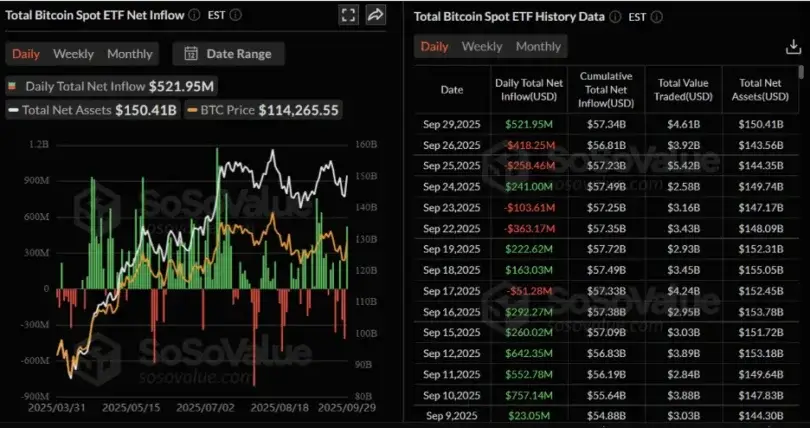
Bitcoin’s rebound has also been supported by a pickup in institutional flows. Data from SoSoValue shows spot Bitcoin ETFs brought in $521.95 million in net inflows on Monday, ending a two-day streak of withdrawals.
The figure marked the strongest single-day inflow since mid-September. Analysts suggest that consistent ETF demand could help stabilize Bitcoin’s price as the market navigates macro and political headwinds.
Corporate activity added to the narrative. Strategy confirmed the purchase of 196 BTC on Monday, increasing its total Bitcoin holdings to 640,031 BTC.
Meanwhile, Kazakhstan unveiled its first state-backed crypto reserve, the Alem Crypto Fund, which aims to allocate long-term investments into digital assets.
“The creation of the Alem Crypto Fund is a step toward advancing digital finance in Kazakhstan. Our goal is to make it a reliable instrument for major investors and a key foundation for digital state reserves,” said Zhaslan Madiyev, Deputy Prime Minister and Minister of Artificial Intelligence and Digital Development.
Seasonal Optimism: The ‘Uptober’ Effect
Bitcoin traders are watching seasonal patterns that have historically favored the fourth quarter.
Data from CoinGlass shows that October has delivered an average return of 21.89% for Bitcoin, a trend often referred to as “Uptober.” The label reflects expectations that the month could once again bring gains if history repeats itself.
Looking beyond October, the fourth quarter has been Bitcoin’s strongest stretch, with average returns of 85.42%.
Market optimism was echoed by Eric Trump, who said, “Q4 will be unbelievable for crypto,” underscoring the positive sentiment building as the year heads into its final months.
Bitcoin Price Analysis
Bitcoin added nearly 2% on Monday, closing above its 50-day Exponential Moving Average (EMA) at $113,313. But by Tuesday, the price slipped to around $112,800, falling just below that same level.
Analysts say holding support near the 50-day EMA is key. If Bitcoin can stabilize there, the path could open toward the next resistance around $116,000. Traders are watching closely to see if momentum builds after the recent rebound.
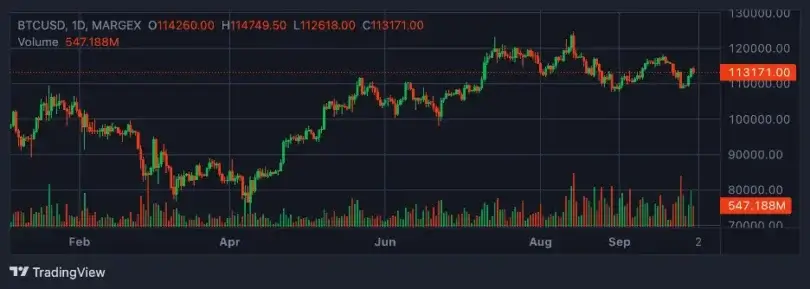
Market signals remain divided. The Relative Strength Index (RSI) sits at 49 after briefly rising above the neutral 50 level on Monday. Analysts note that a sustained move above 50 would strengthen the bullish case.
Meanwhile, the Moving Average Convergence Divergence (MACD) is nearing a bullish crossover. Shrinking red histogram bars also suggest that bearish momentum may be fading.
Together, these signals hint at the possibility of fresh upward momentum if support holds in the coming sessions.
Solana Faces Market Correction as Key Indicators Signal Potential Pullback
Solana (SOL) was trading down at approximately 206 on Tuesday, after a steady increase over the weekend and 2 Monday. The action represents a stalling of a previous momentum, and the token has found itself in a tight trading band of $200 to 205.
But a weak derivatives market and a 15 percent decrease in balances staked in the ecosystem over the past year have cast doubt on whether the fall can go much further.
Solana DeFi TVL and Funding Rates Under Pressure
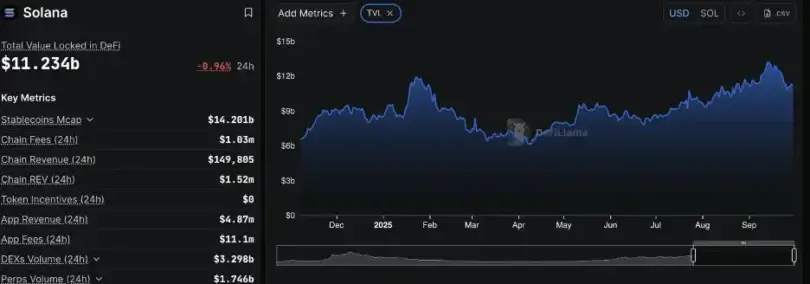
According to DefiLlama, the Decentralized Finance (DeFi) platform of Solana recorded the highest Total Value Locked (TVL) on Sept. 14, when the chain had 13.22 billion locked in its smart contracts.
But the volatility of the greater crypto market, which coincided with the depreciation of SOL to levels around $250, caused a drastic decline in TVL to 10.78 billion on Friday.
DeFi TVL is currently averaging at 11.23 billion on Tuesday, but analysts warn that more might be lost in case SOL drops back to the critical 200 mark. Traditionally, the pullbacks by stakers are likely to occur during a time when declines are expected, and extremely high selling pressure may occur.
As per Coinglass data, the Open Interest (OI) of Solana OI-Weighted Funding Rate has become negative, and it indicates that traders do not prefer to hold long positions but choose to have shorts more often.
Negative funding rates are generally a sign of risk-off, and the market participants point out that the next few days will help to understand whether SOL will be able to get out of below the 220-level, and investors should be ready to suffer further losses under 200.
Solana Price Prediction: Technical Indicators Highlight Bearish Risks
Technically, Solana has dropped below the 50-day Exponential Moving Average (EMA) at $208 following a rejection at or around $215 on Monday. The Relative Strength Index (RSI) did not overcome its midpoint and went down to 44 in the daily chart.
The fact that the RSI has crossed under the mid-line indicates the development of a bearish momentum.
In the meantime, there is a sell signal on the Moving Average Convergence Divergence (MACD) since September 21.
Continued primarily negative sentiment by red histogram bars increases the probability of more significant corrective action.
Analysts caution that the gains may continue to be affected adversely, with SOL plummeting to the psychologically important levels below the 200 mark, in case the current trends are to be sustained.
In case Solana goes further down to the point of below $ 200, the market players will be looking at the 100-day Exponential Moving Average (EMA) of $194 and the 200-day EMA of 182 as a possible support level.
These can be places to relieve the pressure to sell. On the positive side, a rapid recovery above the 50-day EMA can bring in a slow recovery, and the targets will be at the first level of $220 and then in the second level, close to the 250 level of resistance.
Ethereum Gains as BitMine Expands Holdings Beyond 2.65 Million ETH
Etherium (ETH) gained 4% on Monday, continuing its recovery following BitMine Immersion Technologies (BMNR) claiming that it had now amassed over 2.65 million coins of ETH in its treasury.
Nevada-based Ethereum treasury company announced that it had bought 234,850 ETH last week as it continues to accumulate the second-largest cryptocurrency in a systematic way.
The purchase increased its inventories to 2.65 million ETH, which was approximately 10.8 billion dollars, as of the current market prices.
The stash is a value that comprises 2.19 percent of the total circulating supply of Ethereum, as per statistics of Ultrasound Money.
In addition to its Ethereum position, BitMine reported holdings of 194 BTC, a $157 million allocation to the Worldcoin (WLD) treasury, shares in Eightco Holdings, and $436 million in unencumbered cash. Combined, its digital asset and cash reserves amount to $11.6 billion.
BitMine Chairman and Fundstrat CIO Thomas Lee put Ethereum in the middle of two long-term investment stories. With two months to go before we move into 2026, AI and crypto are still the two Supercycle investing stories.
And both need neutral public blockchains. Of course, Ethereum is the best option because it is very reliable and has a high uptime. Lee said these two strong macro cycles will be realized over decades.
He also stated that the company is still determined in its mission to control 5 per cent of the circulating supply of Ethereum. The fact that the price of ETH is a discount in the future is an encouraging sign in the token and the motivation why the key asset in the treasury of BitMine is ETH, thus, we seek the alchemy of 5% of ETH, Lee said.
This new acquisition is after BitMine announced last week that it had sold over 5,217,715 common shares totalling over 365 million for $70 each to an institutional investor. The company initiated its ETH program of acquisition in July, and since then, it has become the biggest publicly traded Ethereum treasury in the world.
Its ETH stockpile of 2.65 million is more than three times that of its closest competitor, SharpLink Gaming (SBET), which has about 838,700 ETH.
The stock of BMNR was performing well on Monday at $53.80, which is a 6% upswing.
As BitMine increases its Ethereum holdings, US spot ETFs of Ethereum posted net sales outflows of 795 million euros per week, according to SoSoValue information indicated. The difference brings out increasing institutional approaches to the asset as the year-end draws closer.


